GeoCities- Social Media Before It Was Easy?
It seems to me that usually before a brave new technology takes the world by storm, there’s an earlier attempt using whatever was available. These earlier attempts are usually a little messier, and not as user friendly, painting the way to their eventual failure and the rise of something that polishes and successfully finishes what they started. So it was with social media.
Because the internet has been around for awhile, and enabling people to get connected for just as long. Before the years approaching the turn of the millennium, it was an area that only dedicated computer aficionados spent much time at, because of how clunky it was, but it was still there, in its nascent form even then representing technology’s ability to connect.
But even in earlier days you had untrained users striving, trying to connect, express themselves as much as they could, pushing at the technical boundaries of what their hardware and skills enabled. It’s this era I think about when I remember GeoCities. This site, began in the mid-90s and eventually shuttered in 2009, was one of the first sites to my limited personal knowledge to really enable expression and content creation for users. And it allowed it without any framework like you get from today’s social media enablers.
This is the key to why the look of these websites are so different, garish, and wild; you don’t have a unifying platform with restrictions on just how or what users could prsent. It’s sort of like 80s music videos- the musical artists and directors at the time were just so taken with all the stuff they could pull off with video effects that they threw it all at the wall.
It’s the same with this decidedly 90s attempt at early user web design. Everyone is taking their claiming their corner of the internet, using it to communicate. What to communicate, most people just fall to their passions- hobbies, pets, favorite bands.
Just look at this stuff: https://oneterabyteofkilobyteage.tumblr.com/


I admit, I get nostalgic for webpages that look like this.
You can laugh, it’s easy to do almost 20 years in hindsight, but what I see so compelling here is people striving to communicate, yearning for expression, for creation. Years of watching your passions being dictated to you from television screens, books, newspapers was over to a degree- you could finally express your own thoughts and love.
And it’s easy to see why social media sites like Facebook, Instagram, and Youtube caught fire like they did- they made this process of expression even easier, and look much nicer, with more possibility of connection. Because replete with the tools to communicate your content was also multiple means of finding it, sharing it. And these social media sites, while perhaps limiting you in a way to one type of expression that fits within their platform, let the site be less about whatever passion you made a GeoCities website about and more about you- you were the passion that you were communicating to the world, and not necessarily how much you love your cat. Now you can share how much you love your cat, and your hobbies, and your slash fiction, all around a photo of where you were on vacation.
But still I sometimes miss this earlier era of internet-ing. .Back in that day, the Internet was a pretty new and exciting place. It still is, certainly, and there’s plenty to find within each social media platform, but that sense of discovery has diminished somewhat. There’s also a sense of uselessness in creating some of these types of pages. Back then, there wasn’t wikipedia (or even a really strong Google). So I had just gotten into my favorite band, The Smashing Pumpkins, and I tried to find out as much about them as I could. That led me to invaluable fan sites with plenty of the information I wanted, filtered through the personalities of the managers of those websites. At this point, today, if I wanted to find info about a band, I’d just go to Wikipedia- there’s no need for me to really visit fansites (unless I just wanted to, and even then, most have shuttered or exist as blogs on places like Tumblr). More than that, there’s no reason for me to even build one! Most information I could really want is located within a wiki of some sort. The wikis are user generated, but in a user curated, codified way. A lot of that voice has been lost.
But perhaps these different feelings I have occasionally are less about the particular facets of the internet that have changed and more about how long the mainstream use of the Internet itself has been around for so long, and I just reminisce about the life changes I experienced as I acclimated to this new technology integrating into everyday life.
“I loved GeoCities. It allowed users to make web pages with minimal effort. I don't understand why Yahoo! is allowing it to die. I presume Yahoo! used the eyeballs that GeoCities generated, and now that it no longer serves their purpose, is allowing it to die. It’s a lost opportunity for Yahoo! They could have made it a Facebook if they wanted,” says Indian internet guru and cyber security expert Vijay Mukhi.
https://www.business-standard.com/article/technology/yahoo-writes-geocities-obituary-109042500035_1.html
Because the internet has been around for awhile, and enabling people to get connected for just as long. Before the years approaching the turn of the millennium, it was an area that only dedicated computer aficionados spent much time at, because of how clunky it was, but it was still there, in its nascent form even then representing technology’s ability to connect.
But even in earlier days you had untrained users striving, trying to connect, express themselves as much as they could, pushing at the technical boundaries of what their hardware and skills enabled. It’s this era I think about when I remember GeoCities. This site, began in the mid-90s and eventually shuttered in 2009, was one of the first sites to my limited personal knowledge to really enable expression and content creation for users. And it allowed it without any framework like you get from today’s social media enablers.
This is the key to why the look of these websites are so different, garish, and wild; you don’t have a unifying platform with restrictions on just how or what users could prsent. It’s sort of like 80s music videos- the musical artists and directors at the time were just so taken with all the stuff they could pull off with video effects that they threw it all at the wall.
It’s the same with this decidedly 90s attempt at early user web design. Everyone is taking their claiming their corner of the internet, using it to communicate. What to communicate, most people just fall to their passions- hobbies, pets, favorite bands.
Just look at this stuff: https://oneterabyteofkilobyteage.tumblr.com/
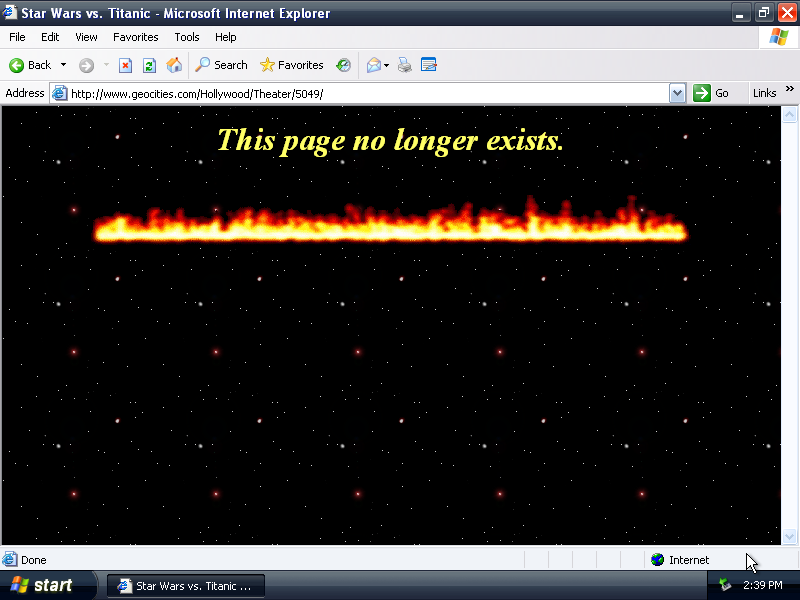
I admit, I get nostalgic for webpages that look like this.
You can laugh, it’s easy to do almost 20 years in hindsight, but what I see so compelling here is people striving to communicate, yearning for expression, for creation. Years of watching your passions being dictated to you from television screens, books, newspapers was over to a degree- you could finally express your own thoughts and love.
And it’s easy to see why social media sites like Facebook, Instagram, and Youtube caught fire like they did- they made this process of expression even easier, and look much nicer, with more possibility of connection. Because replete with the tools to communicate your content was also multiple means of finding it, sharing it. And these social media sites, while perhaps limiting you in a way to one type of expression that fits within their platform, let the site be less about whatever passion you made a GeoCities website about and more about you- you were the passion that you were communicating to the world, and not necessarily how much you love your cat. Now you can share how much you love your cat, and your hobbies, and your slash fiction, all around a photo of where you were on vacation.
But still I sometimes miss this earlier era of internet-ing. .Back in that day, the Internet was a pretty new and exciting place. It still is, certainly, and there’s plenty to find within each social media platform, but that sense of discovery has diminished somewhat. There’s also a sense of uselessness in creating some of these types of pages. Back then, there wasn’t wikipedia (or even a really strong Google). So I had just gotten into my favorite band, The Smashing Pumpkins, and I tried to find out as much about them as I could. That led me to invaluable fan sites with plenty of the information I wanted, filtered through the personalities of the managers of those websites. At this point, today, if I wanted to find info about a band, I’d just go to Wikipedia- there’s no need for me to really visit fansites (unless I just wanted to, and even then, most have shuttered or exist as blogs on places like Tumblr). More than that, there’s no reason for me to even build one! Most information I could really want is located within a wiki of some sort. The wikis are user generated, but in a user curated, codified way. A lot of that voice has been lost.
But perhaps these different feelings I have occasionally are less about the particular facets of the internet that have changed and more about how long the mainstream use of the Internet itself has been around for so long, and I just reminisce about the life changes I experienced as I acclimated to this new technology integrating into everyday life.
“I loved GeoCities. It allowed users to make web pages with minimal effort. I don't understand why Yahoo! is allowing it to die. I presume Yahoo! used the eyeballs that GeoCities generated, and now that it no longer serves their purpose, is allowing it to die. It’s a lost opportunity for Yahoo! They could have made it a Facebook if they wanted,” says Indian internet guru and cyber security expert Vijay Mukhi.
https://www.business-standard.com/article/technology/yahoo-writes-geocities-obituary-109042500035_1.html

OK, wow - that took me back! I remember thinking how "tech savvy" I was because I could create those sites! Looking back, of course, is embarrassing. Web 2.0 certainly allows for much better engagement, but I've found those earlier sites were much easier to construct, of course. Nostalgic, definitely!
ReplyDeleteI just want to add and get your insight... are you as annoyed as I am by websites that have enormous header graphics that take up the entire screen when you open? So many website themes do this now a days and I think I have have one like that because it is so common, but I wonder if people really like it or if it is just me.
ReplyDelete